← Back to blog

technology

Why STEP stays the practical CAD standard

STEP is still the most reliable neutral format for cross-system geometry exchange.

STEP stands for Standard for the Exchange of Product model data, defined in ISO 10303. The standard was first published in 1994 and has been revised steadily since. The two application protocols you will encounter most in manufacturing are AP203 (configuration-controlled 3D design) and AP214 (automotive mechanical design processes). AP242, the newer revision, adds model-based definition capabilities including GD&T embedded in the file itself.

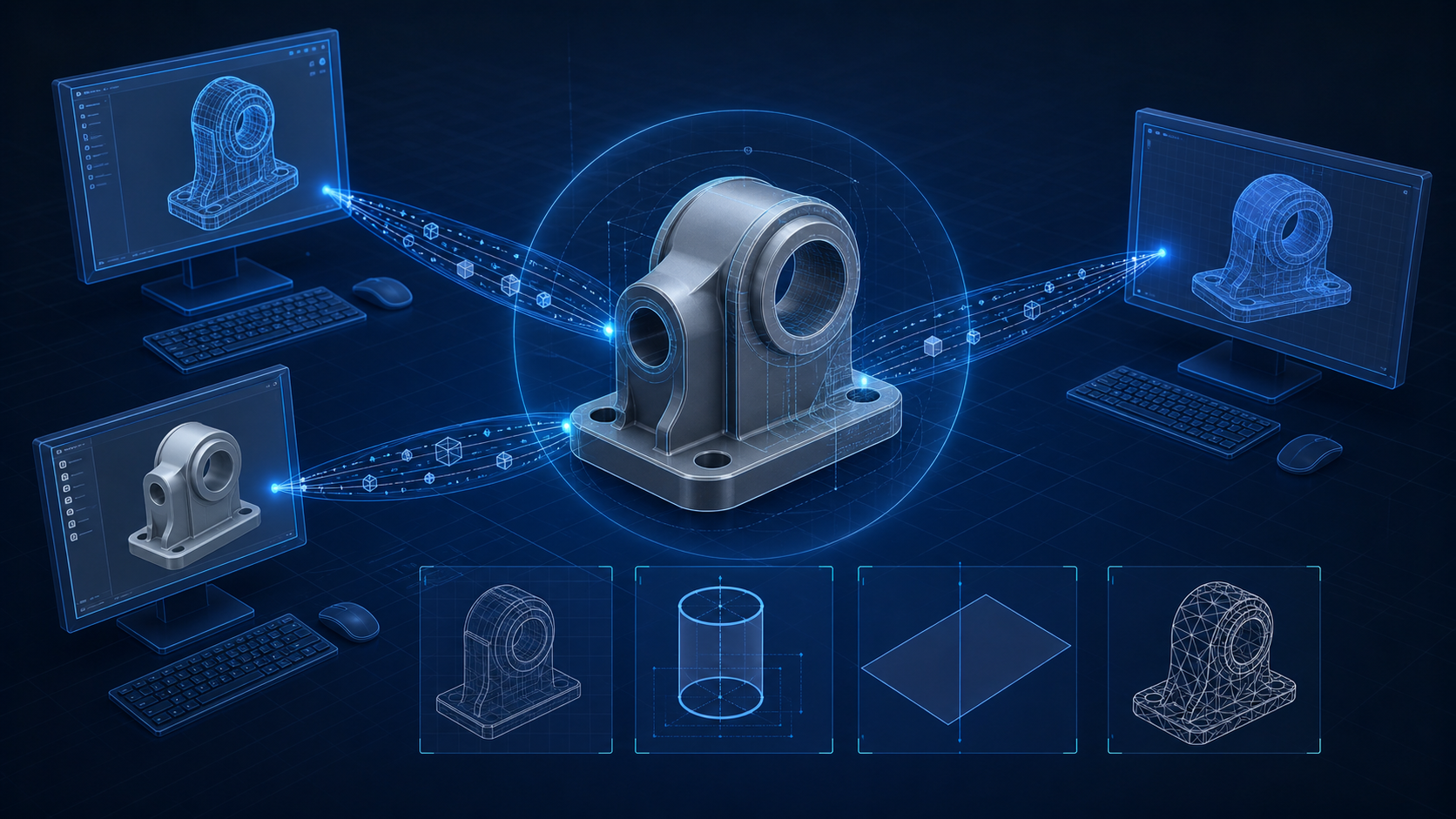
What makes STEP different from STL or OBJ is the geometry representation. STL approximates surfaces with triangles — the more triangles, the closer the approximation to the real shape, but it is always an approximation. STEP stores exact boundary representation (B-rep) geometry: mathematical surfaces like planes, cylinders, cones, and NURBS defined precisely. That matters for quoting because volume and surface area calculated from B-rep are accurate, while volume from triangulated formats is only as good as the tessellation density.

Why not use native formats like SolidWorks .sldprt or CATIA .CATPart? Because those formats are proprietary and version-locked. A shop running SolidWorks 2024 cannot reliably open a CATIA V5 file without a translator, and that translator may not handle every feature correctly. STEP was designed specifically to be the neutral handshake between systems — and despite decades of alternatives (IGES, JT, 3MF), it has remained the most widely accepted format in industrial supply chains.

For automated quoting, three dimensions from a STEP file matter most: volume (drives material cost), surface area (drives finishing and coating cost), and bounding box (determines whether the part fits in the machine envelope). A reliable B-rep parser can extract all three in under a second on typical part sizes. DemoQuoter uses pythonOCC, the Python binding to OpenCASCADE Technology, which is the same geometry kernel used in FreeCAD and several commercial CAD systems.

Common problems with STEP files submitted for quoting: assemblies exported as a single merged body (you get one volume but cannot identify individual parts), scale errors when the CAD system exports in millimeters and the receiving system assumes inches, and missing or empty shells when a feature fails to translate cleanly. A robust validator should check for closed solids, non-zero volume, and reasonable bounding box aspect ratios before attempting to price anything.

STEP also carries metadata that is useful beyond geometry: part number, description, and unit of measure are often embedded in the header. Some exporters include material designation and surface finish callouts in the product definition data. DemoQuoter reads the header metadata but does not rely on it for pricing — geometry is the ground truth, and any metadata found is presented to the operator as a cross-check.

There is ongoing work in the industry to move toward model-based enterprise (MBE) workflows where STEP AP242 files carry tolerances, surface finishes, and inspection requirements directly rather than relying on a separate 2D drawing. For quoting, that shift is significant: it means pricing can eventually be derived entirely from the 3D file, reducing the ambiguity that currently forces estimators to request clarification from customers before committing to a price.