technology
How DemoQuoter calculates: formulas, demo assumptions and limits
The complete, reproducible path from STEP geometry to production cost, mold price and quote total — including every default used by the demo.
There is no hidden market-price model behind DemoQuoter. The browser sends the geometry and selected assumptions to the backend; the backend applies the formulas below and returns both the price and its breakdown. The same input therefore produces the same result.
This demo models injection-molding economics with plausible example values. It is representative of how a quote can be structured and how cost drivers react, but it is not calibrated to a particular factory. A production deployment replaces these defaults with the manufacturer’s materials, presses, setup rules, margins and approval process.
The initial demo request is 1,000 ABS parts, one cavity, cold runner, standard finish, normal tolerance and tooling included. The result is marked preliminary. Every selection can be changed before export.
- Deterministic and inspectable: geometry, assumptions, intermediate costs and formulas remain visible.
- Useful for a fast, consistent first indication and for comparing variants under the same rules.
- Not a production-ready promise: drawings, manufacturability, special features and commercial conditions still require review.
1. What comes from the STEP file
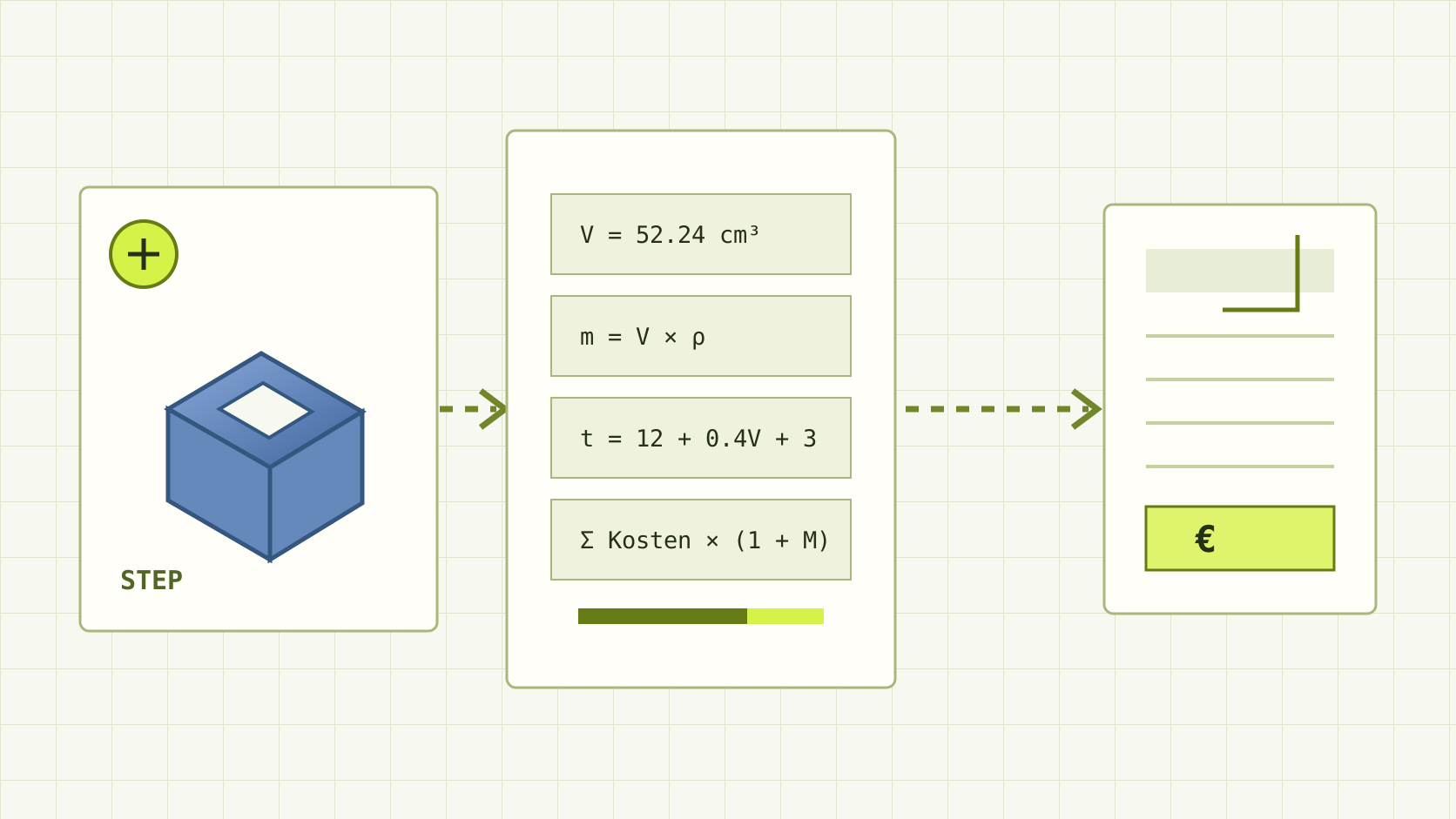
The OpenCascade analysis supplies volume, surface area, bounding-box dimensions, the largest face area and the number of faces. For pricing, the algorithm uses volume, dimensions, largest face and face count. Surface area is shown for engineering review but is not a direct cost driver in this demo.
Projected area is approximated as the largest of the three bounding-box sides and the largest detected face. Size then becomes small, medium, large or extra-large. Complexity is deliberately simpler: up to 50 faces is simple, up to 120 medium, up to 250 complex, and anything above that very complex. Face count is a reproducible proxy, not proof of mold complexity.
- Small: projected area ≤ 10,000 mm² and largest dimension ≤ 100 mm
- Medium: ≤ 40,000 mm² and ≤ 300 mm
- Large: ≤ 160,000 mm² and ≤ 600 mm; otherwise extra-large
2. Material and cycle time
Part weight equals volume × material density. A runner allowance is added to obtain shot weight: 30% for a cold runner, 5% for a hot runner and 0% for no runner. Material cost per part is shot weight in kilograms × resin price × (1 + scrap rate).
If the operator does not enter a cycle time, the demo estimates it as 12 seconds + 0.4 seconds per cm³ of part volume + 3 seconds handling, limited to 8–90 seconds. This makes larger parts take longer without pretending to be a filling-and-cooling simulation.
- ABS: 1.04 g/cm³, €2.80/kg, 8% scrap
- PP: 0.91 g/cm³, €1.90/kg, 6% scrap
- PA6: 1.14 g/cm³, €3.60/kg, 10% scrap
3. Production price per part
Machine cost is effective hourly rate × cycle time ÷ 3,600 ÷ cavities. The effective rate is the €55/hour demo rate divided by 85% utilization. Direct labor uses the same time allocation: labor rate × hands-on seconds per cycle ÷ 3,600 ÷ cavities.
The default setup is 2 hours at €60/hour, or €120, allocated across the order. Packaging and quality allowances are added per part. Material, machine, labor, setup, packaging and quality form the production cost; the demo adds a 25% production margin. Quantity affects the unit price mainly because one-time setup is spread over more or fewer parts.
- Direct labor: 0 seconds/cycle by default, with a stored rate of €35/hour
- Packaging: €0.02/part; quality allowance: €0.00/part
- All these values can be replaced in the advanced calculation basis
4. Mold price
Mold cost before margin equals base mold × cavity factor × complexity factor × finish factor × tolerance factor + runner surcharge. Base costs by size are €3,000, €8,000, €18,000 and €40,000. The demo then adds a 10% tooling margin if tooling is included.
The cavity factors for 1, 2, 4, 8 and 16 cavities are 1.00, 1.35, 1.85, 2.70 and 4.00; another cavity count uses the nearest lower configured factor. Complexity factors are 1.00, 1.15, 1.35 and 1.65. Finish factors are 1.00 standard, 1.15 textured and 1.25 polished. Tolerance factors are 0.90 coarse, 1.00 normal, 1.20 tight, 1.40 very tight and 1.75 critical. A hot runner adds €1,500 to the mold baseline.
The backend also has a separate, deterministic path for reviewed manufacturing features: a confirmed undercut, internal thread or external thread can add a configured allowance of €1,500, €2,500 or €1,800 before tooling margin. The public demo does not automatically approve these features and submits zero unless they have been explicitly confirmed through an integrated review workflow.
5. From calculated price to quote
Production total is selling price per part × quantity. The final total is production total + tooling price; the all-in unit figure divides that total by quantity. Calculations stay in the backend. The frontend only collects inputs, requests recalculation and displays the returned breakdown.
An estimator may overwrite the calculated production total or tooling price before export. DemoQuoter keeps the original calculated values alongside the manual values and derives the final total from the approved numbers. This separates a formula result from a commercial decision.
6. Why this is representative — and where it stops
The structure is representative because it uses the same families of drivers that matter in real injection-molding estimates: consumed resin, cycle and press capacity, cavities, setup, labor, order quantity, mold size, construction effort, finish and tolerance. It also reacts in the expected direction: more cavities reduce machine cost per part but increase mold cost; tighter tolerances and polished surfaces increase tooling; larger quantities dilute setup and tooling per part.
Representative does not mean universally correct. The cycle formula is a heuristic, projected area does not calculate clamp force, and face count cannot identify slides, lifters, cooling layout or every thread and undercut. The STEP model contains nominal geometry but often not drawing tolerances, resin grade, color, inspection plan, logistics, taxes or payment risk. Those items are outside the current demo price.
If you want to see how this approach works with your real calculation rules, we can test it together. In a pilot, we compare historical parts and quotes, calibrate rates and edge cases, and define review gates before connecting the approved result to your documents, ERP and sales workflow.